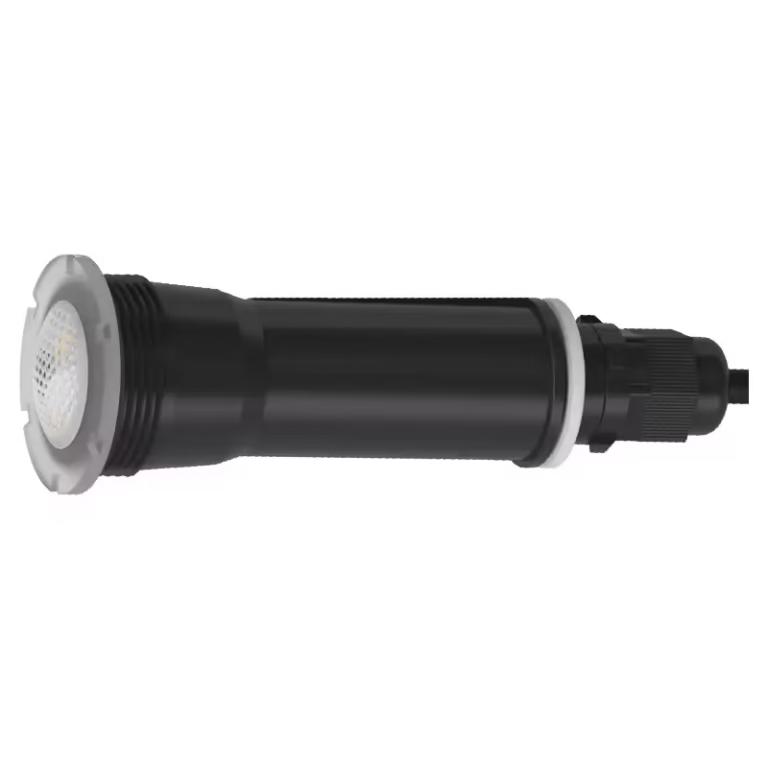
If you have replaced three lights in the past five years, do not blame your luck. Do not blame your water chemistry. You are a victim of "physics inevitability."
When a heated electronic component is wrapped in a hollow plastic shell and thrown into cold water, failure is not a possibility. It is a matter of time. The design creates thermal stress that cracks the housing, allowing water intrusion regardless of seal quality.
I have faced this situation many times in my career. You install a trusted brand, but the phone rings months later with a complaint. I want to explain the real engineering reasons behind these failures.
Expectation vs. Reality: What is the Life Expectancy of a Pentair Globrite?
You see the box say 30,000 hours. You expect years of service. But the reality in the field is much shorter. Why is there such a big gap between the promise and the product?
The 30,000-hour claim refers to the LED diode in a lab, not the fixture in a pool. The plastic housing suffers fatigue within 2-3 years. Once the shell breaks, the long-lasting LED inside becomes useless.
!
Pentair and other big brands market their products based on theoretical data. They tell us the LED light source lasts for 30,000 hours. This is technically true for the diode itself. However, this is like saying a human heart can beat for 100 years. If you throw that human into the deep ocean without an oxygen tank, they will not live for more than three minutes. The environment matters more than the theoretical limit.
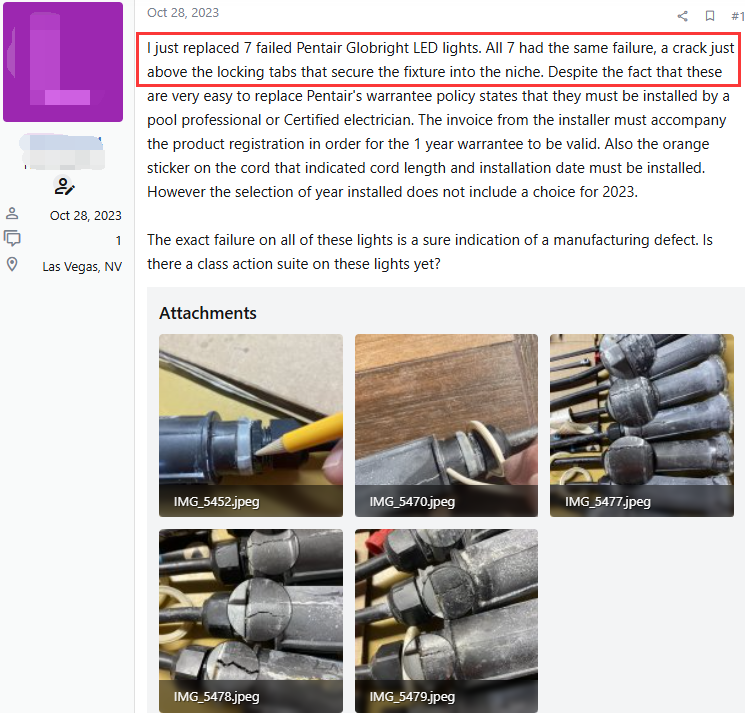
The weak point of a Globrite is not the electronics. The weak point is "Housing Fatigue." Swimming pools are harsh environments. We use chlorine, acid, and salt. These chemicals attack plastic over time. But the temperature changes are the real killer. The light heats up, and the water cools it down. The plastic shell expands and contracts every day.
This constant movement weakens the structure. The plastic eventually reaches its limit. It develops small cracks. We are paying a premium price for a "long-life" LED, but it is packaged in a "short-life" shell. We are buying a Ferrari engine and putting it inside a cardboard car. When the car falls apart, the engine does not matter.
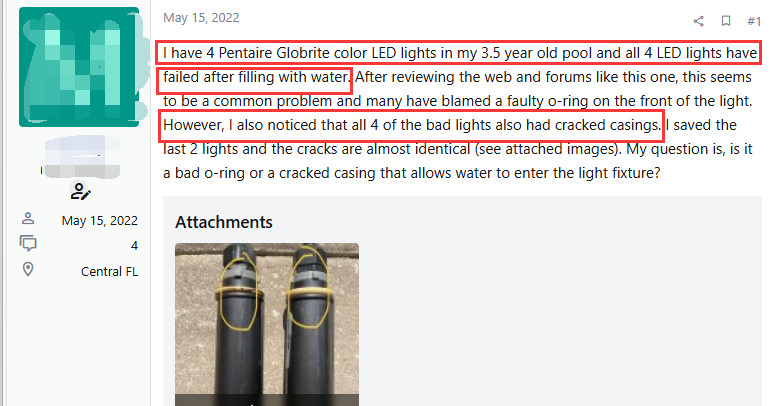
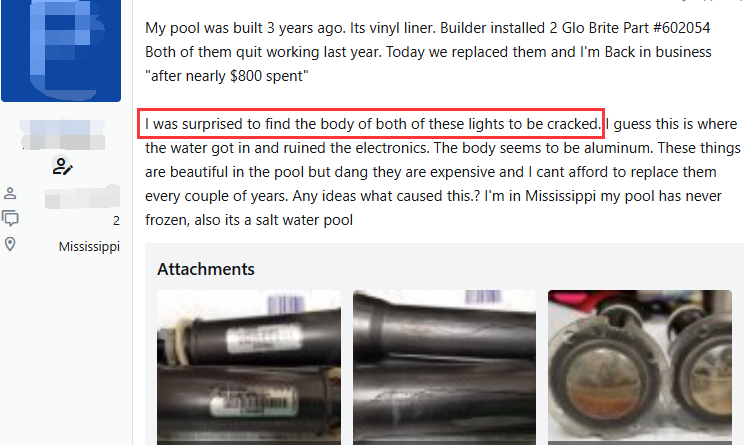
Why the Housing Fails First
| Factor | Effect on Plastic Housing | Result |
|---|---|---|
| Chemical Exposure | Chlorine makes plastic brittle. | Cracks form easily. |
| Thermal Cycling | Daily expansion and contraction. | Structural fatigue. |
| Water Pressure | Constant external force. | Water finds weak spots. |
The "Thermal Trap": Why Do LED Bulbs Fail So Often Underwater?
Many pros think the gasket failed. They try to seal it better with silicone. But the problem is not the seal. The problem is the air inside the light.
Standard hollow lights act like water pumps. When on, air expands and pushes out. When off, air cools and creates a vacuum. This negative pressure actively sucks water in through microscopic cracks.
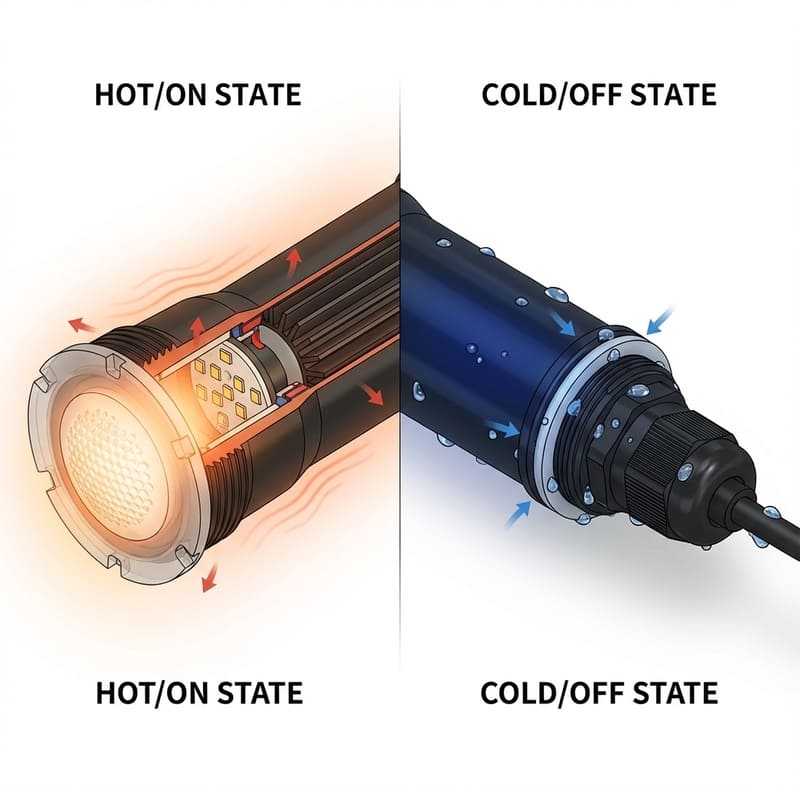
Most people assume water gets in because an O-ring gets old. The truth is much scarier. The Globrite design uses an air-filled cavity. This design flaw creates a physical suction cycle. I call this the "Thermal Trap." Your pool light effectively becomes a low-speed water pump.
Here is how the physics works in your customer's pool:
- The Expansion: The light turns on. The electronics generate heat. The air inside the hollow lens gets hot. Hot air expands. This creates "Internal Pressure." It pushes against the plastic lens and the seals.
- The Vacuum: The timer turns the light off. The surrounding water is cold. The air inside the light cools down very fast. Cool air shrinks. This creates a vacuum inside the lens.
- The Intrusion: Nature hates a vacuum. The negative pressure inside the light pulls on the outside environment. It will suck water in through any path it can find.
It does not need a large hole. The vacuum is strong enough to pull water through cracks that are smaller than a human hair. These are the micro-cracks caused by the housing fatigue I mentioned earlier. Once the water enters, it hits the hot circuit board. The light fails instantly. This is why you cannot just "seal it better." You are fighting physics.The Cycle of Destruction
- Step 1: Heat expands air (Push out).
- Step 2: Cold contracts air (Pull in).
- Step 3: Vacuum sucks water through micro-fractures.
- Step 4: Circuit board shorts out.
The Financial Black Hole: What is the Average Cost to Replace a Pool Light Over 5 Years?
You worry about the price of the light today. But the real cost is the replacement labor. Callbacks destroy your profit margins quickly and damage your local reputation.
Cheap plastic lights cost you more in unbillable labor. Every time a light fails under warranty, you lose fuel, time, and reputation. The true cost includes these hidden expenses over a five-year period.
As a business owner, I look at the bottom line. The initial price of a product is only one part of the equation. We suffer from "margin squeeze" every year. The big distributors take their cut, and manufacturers raise prices. We struggle to pass these costs to the homeowner. But the biggest thief of profit is the "Dreaded Callback."
Let us look at the math. You install a brand-name plastic light. You make a small profit on the install. Six months later, the lens cracks. The customer calls you. They are angry. You feel embarrassed because you sold them a "top brand." Now you have to go back.
You drive your truck there. That costs fuel and wear and tear. You pay your technician for the travel time and the work time. You cannot bill the customer for this. It is warranty work. You also spend time on the phone fighting with the manufacturer's warranty department. They might deny the claim.
If you have to replace that light two or three times in five years, you have lost money on that client. You are paying for the privilege of working. This is a financial black hole. A slightly cheaper light that fails is infinitely more expensive than a reliable light that stays working. We need products that protect our time, not just products that have a famous logo.
The True Cost of Failure
- Unbillable Labor: Paying staff to fix free work.
- Truck Expenses: Fuel and maintenance for return trips.
- Opportunity Cost: You could be doing a paying job instead.
- Reputation Damage: The customer trusts you less.
Engineering Honesty: How Does Resin-Filled Technology Break the Cycle?
We cannot fix this with better plastic. We cannot use thicker gaskets. We must change the physical state of the light itself.
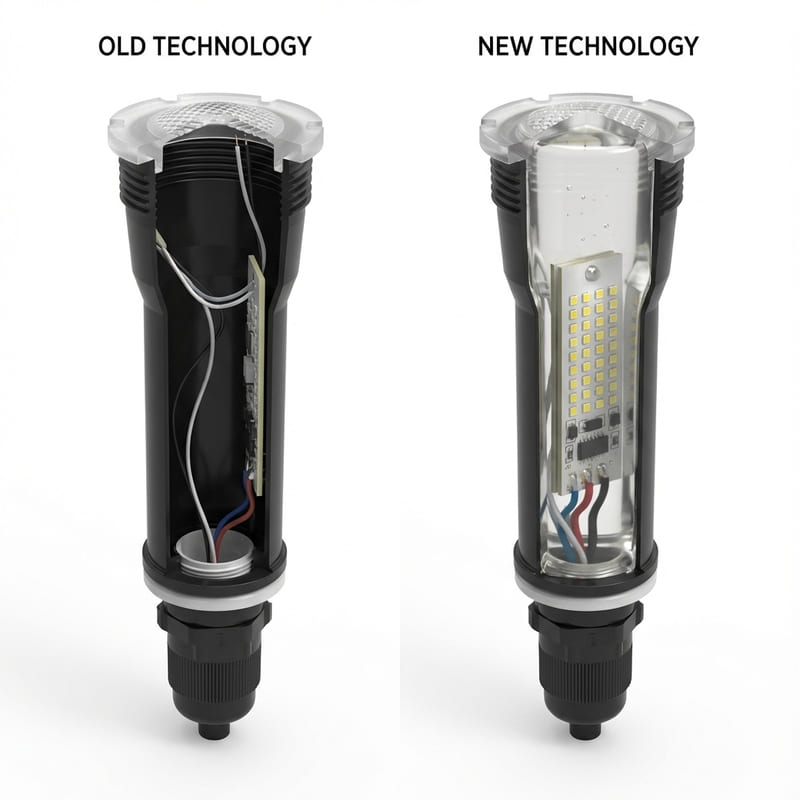
The only solution is Fully Resin-Filled technology. This replaces the air pocket with solid resin. It removes the vacuum effect, improves heat dissipation, and makes water intrusion physically impossible.

The solution to the Globrite failure is not "better plastic." The solution is to change the physics. We need to move from a gas-filled device to a solid-state device. This is where Fully Resin-Filled technology changes the game. It is an honest engineering approach to a difficult problem.
In this manufacturing process, we do not leave the inside of the light hollow. We inject a specialized liquid resin into the entire housing. This resin cures and becomes a solid block. The electronic components are completely encased inside this solid material. This changes everything about how the light functions underwater.
First, it eliminates the "Thermal Trap." Since there is no air inside, there is no expansion and no contraction. There is no vacuum created when the light cools down. It cannot suck water in because there is no empty space for the water to go.
Second, the resin acts as a heat sink. In a hollow light, heat stays trapped near the LED. In a resin-filled light, the resin pulls the heat away from the board and transfers it to the water. This keeps the electronics cooler and extends their life. This is the difference between a toy and a professional tool.Why Resin Wins
- Zero Air Gap: No expansion/contraction cycle.
- Waterproof: Water cannot enter a solid block.
- Thermal Management: Better heat transfer to the water.
- Durability: Resistant to pressure and impact.
| Feature | OEM Globrite (Air-Filled) | Resin-Filled Alternative |
|---|---|---|
| Internal Structure | Hollow (Contains Air) | Solid (100% Resin) |
| Thermal Effect | Expands & Contracts | Stable (No Movement) |
| Water Intrusion Risk | High (Vacuum Suction) | Zero (No Gap) |
Conclusion
Stop relying on hollow plastic lights that act as water pumps. Switch to resin-filled technology to eliminate callbacks, protect your margins, and restore your confidence in the products you install.
Are you a contractor tired of warranty callbacks?
We know you want to fix this permanently. Contact us today to request a free demo unit or unlock exclusive installer pricing. Stop paying for Pentair's design flaws.
✍️ About the Author
[Howard Wang] – Senior Product Engineer
With over 10 years of experience in the swimming pool equipment industry, Howard specializes in LED thermal management and waterproofing solutions. He works directly with US distributors and contractors to develop resin-filled alternatives that solve common OEM failure points.