Seeing your pool lights flashing red and green out of nowhere is definitely frustrating. You're probably wondering if the light is completely dead or if it's just a weird glitch.
Before you panic and call a pool tech, take a breath. In my years of dealing with LED pool lighting, there are three common reasons for a blinking light: the lights are simply out of sync, there is a voltage drop in your wiring, or—the worst-case scenario—water has breached the fixture and fried the circuit board.
Most of the time, this isn't as serious as it looks. Let's walk through exactly how to troubleshoot this, step by step, so you don't waste money replacing a light that just needs a quick reset.
Reason 1: The Lights Are "Out of Sync" (A Simple Memory Glitch)
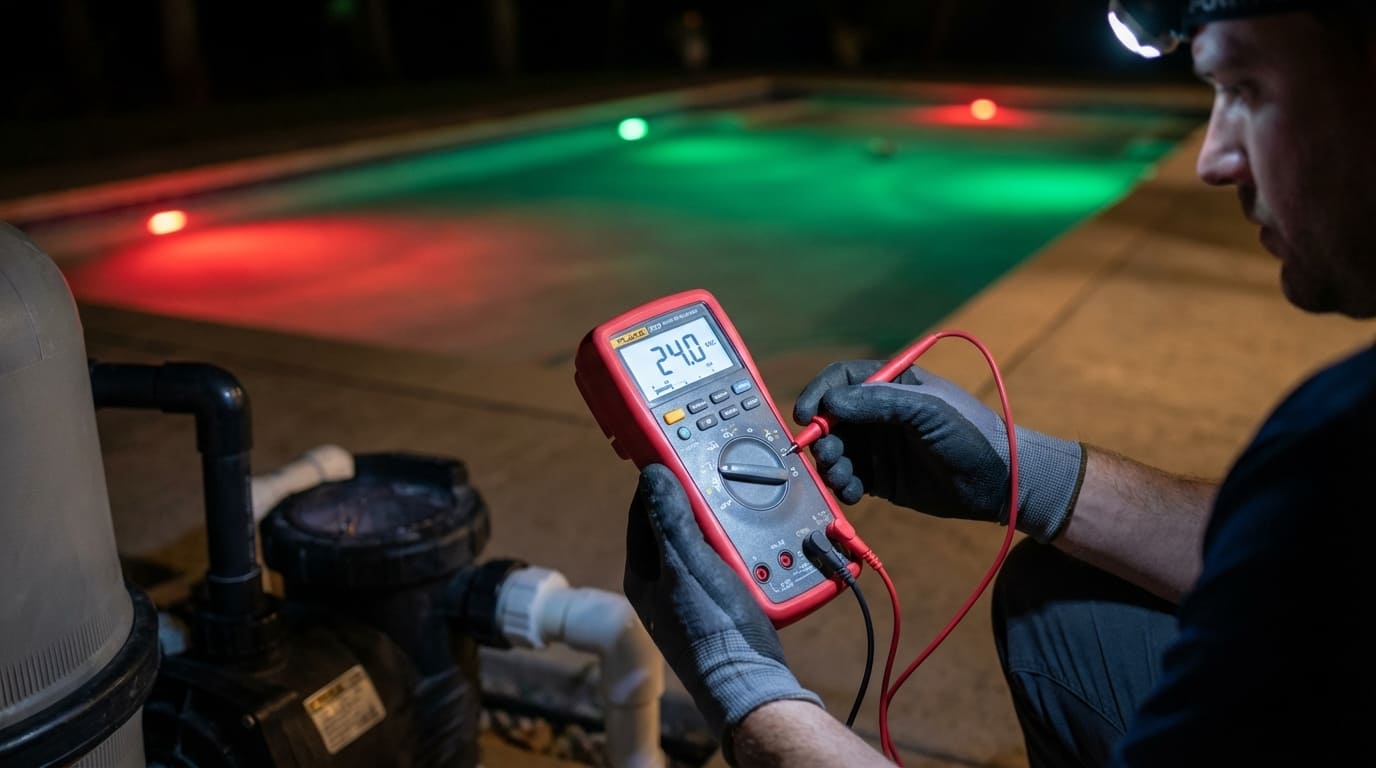
You look at your pool. One light is red, the other is green. It looks like a broken disco.
Here is the good news: Modern LED pool lights have a microchip inside with a memory function. Sometimes, due to a quick power flicker, or even just differing factory default settings when you first install them, the chips lose their shared position in the color sequence.
This isn't a damaged light—it's just a sync error. One light is simply a step behind the other. You just need to force them to "catch up" with each other.
How to sync your pool lights (The Rapid Reset):
| Step | Action | Why it works |
|---|---|---|
| 1 | Turn the pool lights ON. | Start with the lights powered up. |
| 2 | Quickly flip the wall switch OFF, then ON. | Do this rapidly (don't wait too long). |
| 3 | Repeat this rapid toggling multiple times. | This forces the microchips to cycle through their programs. |
| 4 | Stop when both lights show the EXACT SAME color. | Once they match, they are successfully synced back together! |
From here on out, every normal switch flip will move them together through the same color shows. No parts needed, no service call required. If the random blinking continues after you've tried this a few times, move on to Reason 2.
Reason 2: Voltage Drop or Transformer Issues
If the rapid reset didn't work, or if a single light is constantly flickering even on a solid color mode, you are likely looking at an electrical issue.
LED chips require stable power. If they don't get it, they constantly restart themselves, which looks exactly like erratic blinking.
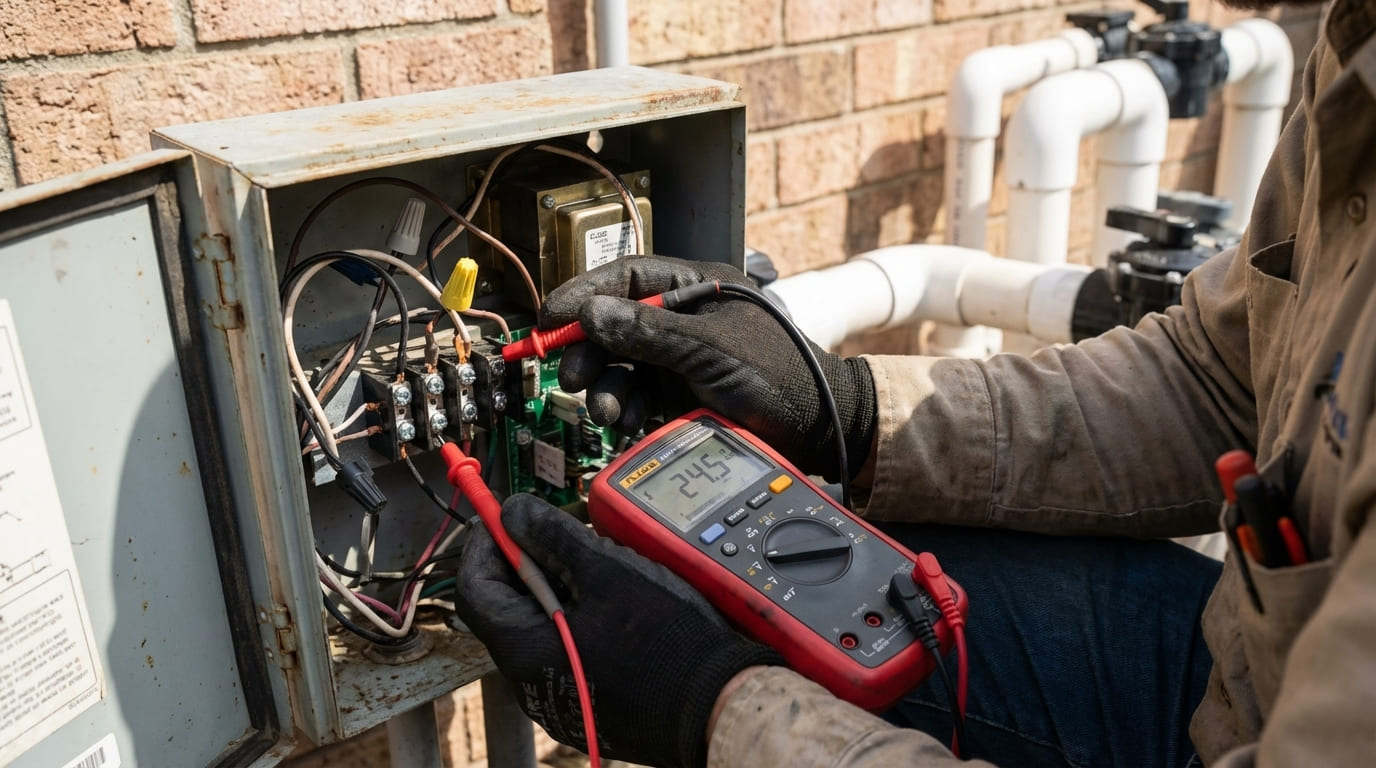
The "Voltage Drop" Trap
The longer your cable run (from the equipment pad to the pool wall), the more voltage is lost due to natural resistance in the wire. On a 12V system, this matters a lot. If a 12V light is only receiving 10V by the time the power travels down 100 feet of wire, the chip will struggle to stay on.
Pro Tip: Always Oversize Your Transformer
To combat this circuit loss, you need to ensure your transformer has more than enough wattage capacity. Don't just buy a transformer that barely meets the total wattage of your lights. A larger, higher-capacity transformer handles line loss much better and provides a much more stable power supply. Additionally, if your transformer has multiple taps (like 12V, 13V, 14V), a qualified electrician can switch to a higher tap to push enough juice through that long cable.
(Note: Also double-check that you didn't accidentally install a 120V bulb on a 12V system, which will cause endless flickering.)
Reason 3: Water Intrusion (The PCB is Fried)
You tried the reset. Your transformer is properly sized and pushing good voltage. But the light is still stuck blinking randomly and won't respond to anything.
It's time to face the music: Water has likely entered the fixture.
When moisture breaches a failed gasket or a cracked plastic housing, it reaches the Printed Circuit Board (PCB). The water creates short circuits, causing the chip to go crazy and send random, logic-less color commands (red, green, flashing) to the LEDs.

If you see condensation inside the lens, or if the GFCI breaker trips repeatedly, stop troubleshooting. Once a traditional hollow pool light gets water inside, it cannot be repaired. You need a replacement.
How to Avoid Leaks When Replacing Your LED Pool Light
If your light died from water damage, you need to understand why it failed so you don't end up replacing it again in two years.
Traditional hollow lights rely on rubber gaskets and plastic ultrasonic welds. As the light heats up and cools down every night, the air inside expands and contracts, eventually cracking the seal and pulling water in.
The permanent fix? Switch to a Fully Resin-Filled Fixture.
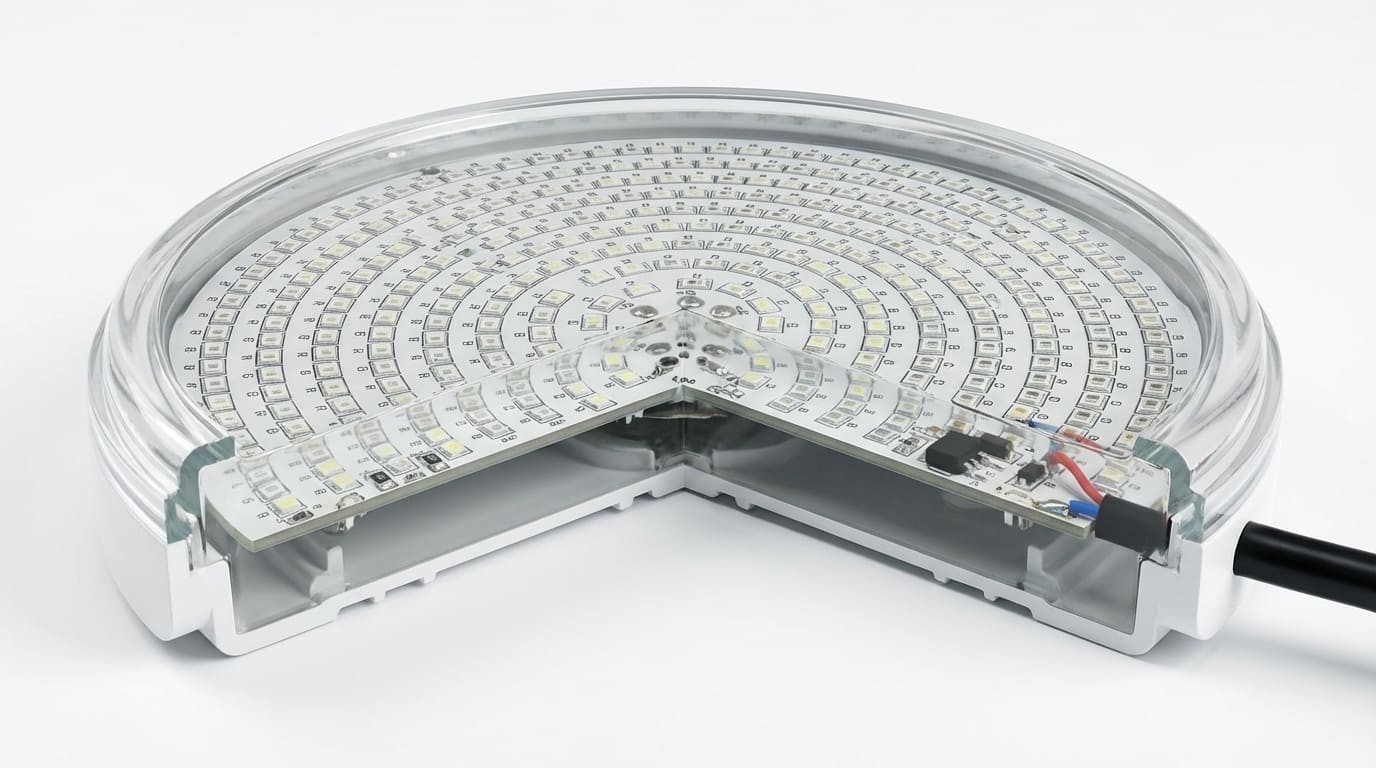
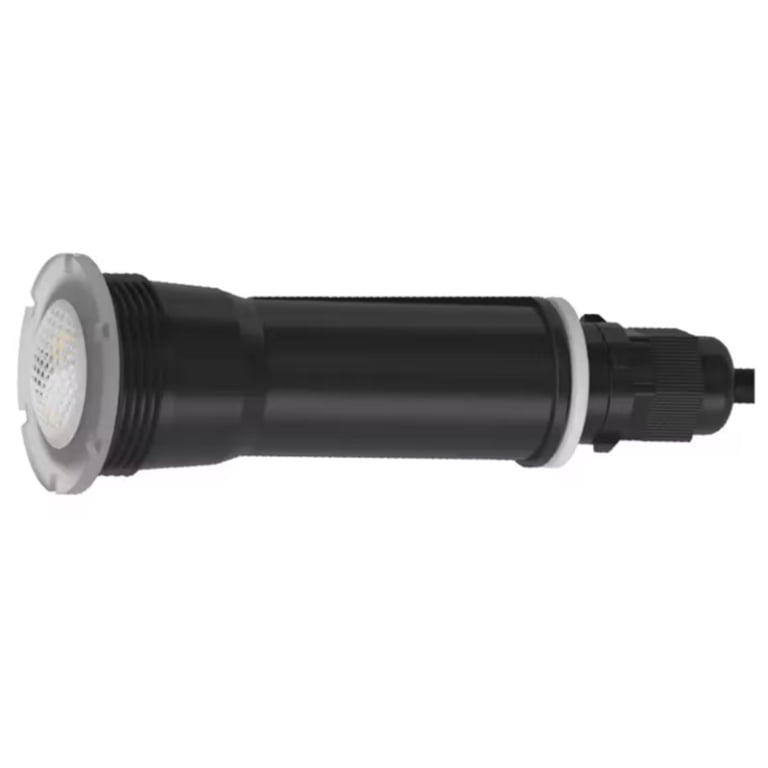
In a resin-filled light, the entire internal assembly is cast in a solid block of epoxy resin. There is no air gap. There is no rubber gasket to degrade over time. It makes water intrusion physically impossible.
To be completely transparent: Even a high-end resin-filled light can get "out of sync" if your power drops (as we discussed in Reason 1). But that is just a software glitch you can fix with a light switch. What a resin-filled light will do is prevent the fatal hardware death caused by water leaks.
| Feature | Standard Hollow LED Light | Upgraded Resin-Filled Light |
|---|---|---|
| Internal Structure | Air + Electronics | 100% Solid Resin Block |
| Water Intrusion Risk | High (gaskets degrade) | None (physically sealed) |
| Thermal Expansion | Causes housing to crack | Zero |
| Can go out of sync? | Yes | Yes (but easily fixed via reset) |
Ready to fix your pool lighting for good?
One callback or early failure costs more than the price difference between these fixtures. If you're replacing a dead traditional pool light, a fully compatible resin-filled unit is the only replacement that makes sense.
We supply upgraded, 100% waterproof LED pool lights directly to homeowners and contractors.
👉 Click Here to Shop Our Fully Compatible Resin-Filled LED Lights
📧 Have questions about compatibility? Email us:[[email protected]]
✍️ About the Author
Howard Wang – Senior Product Engineer
With over 10 years of experience in the swimming pool equipment industry, Howard specializes in LED thermal management and waterproofing solutions. He works directly with US distributors and pool builders to develop reliable, resin-filled alternatives that permanently solve common OEM failure points.