If your pool light trips the breaker every time it rains, you are likely dealing with a moisture-related electrical fault somewhere in the lighting system. Rain itself does not cause a properly installed pool light circuit to trip — it simply exposes a problem that may have been developing for weeks or months.
This is one of the most common pool lighting service calls after heavy storms, especially on older pools with aging fixtures, junction boxes, and underground conduit runs.
Quick Answer
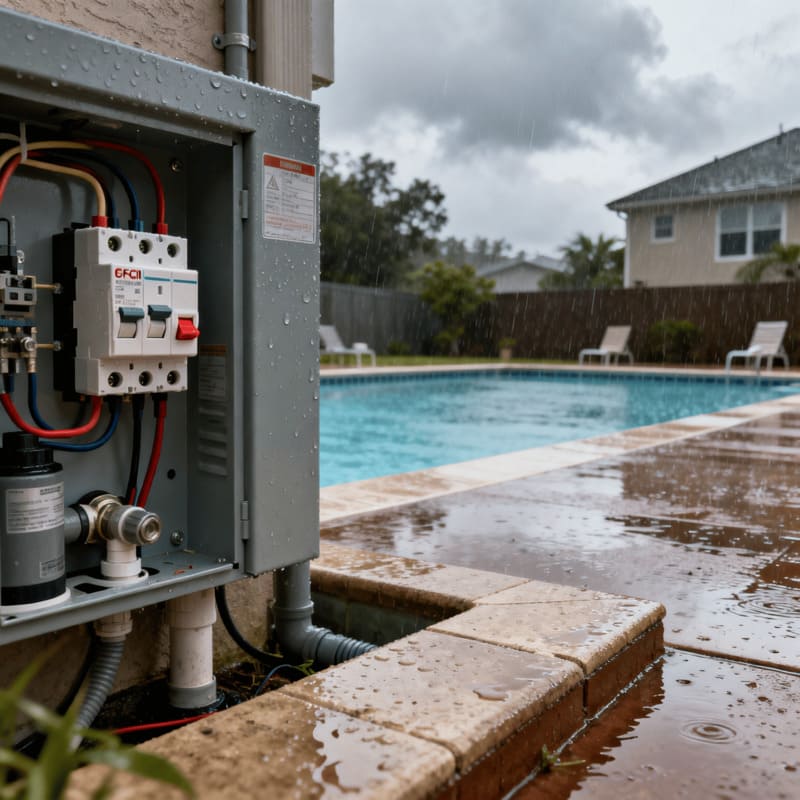
A pool light that trips the breaker after rain is commonly caused by moisture intrusion inside the light fixture, junction box, conduit, or wiring system. When moisture creates a leakage path to ground, the GFCI detects the fault and shuts the circuit down.
If the breaker only trips after rain but operates normally during dry weather, the problem is usually moisture-related rather than a defective breaker.
The most common failure points are:
- Water intrusion inside the light fixture
- Moisture inside the junction box
- Damaged cord insulation
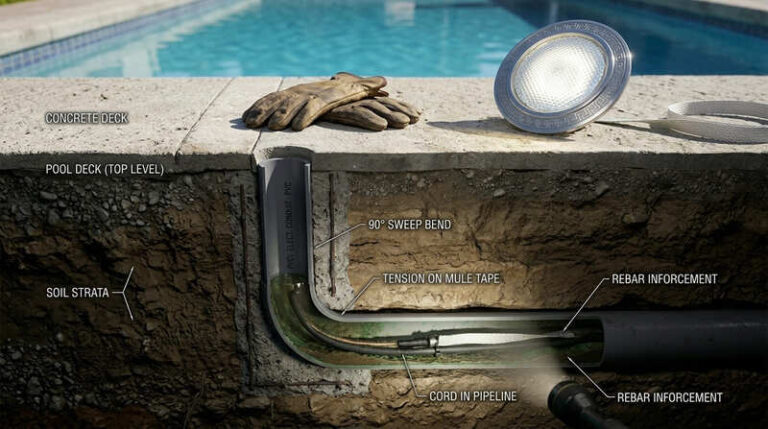
- Water-filled conduit
- Corroded wire splices
This type of problem rarely improves on its own and typically becomes worse over time.
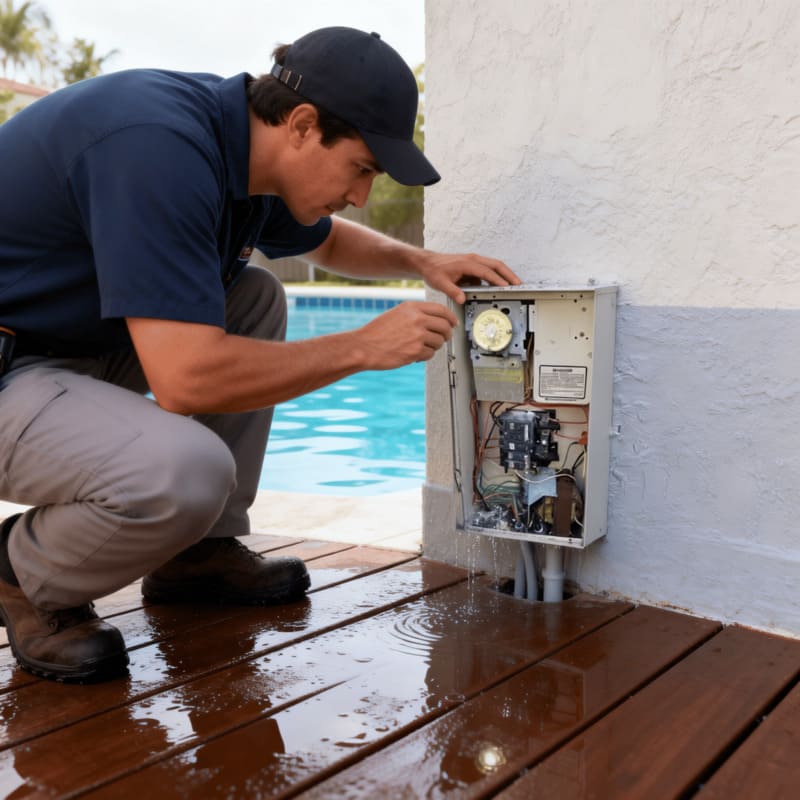
Is Water Intrusion Inside the Pool Light the Most Common Cause?
In my experience, yes.
Many pool lights that begin tripping breakers after rain eventually show signs of water intrusion inside the fixture itself.
Modern pool lights rely on seals around the lens, housing, and cord entry point. Over years of thermal cycling, vibration, chemical exposure, and normal aging, those seals can deteriorate.
Once moisture reaches the internal electronics, leakage current begins to develop.
Common warning signs include:
- Fog or condensation behind the lens
- Water droplets inside the fixture
- Corrosion near the cord entry
- Flickering or dimming before trips begin
- Color-changing lights behaving erratically
- Older fixtures approaching the end of their service life
In some cases, a light may continue operating intermittently for weeks or months before complete failure occurs.
The challenge is that once significant moisture intrusion reaches the internal electronics of a sealed LED fixture, replacement is usually the most reliable long-term solution.
Can Rainwater Enter the Junction Box or Conduit?
Absolutely.
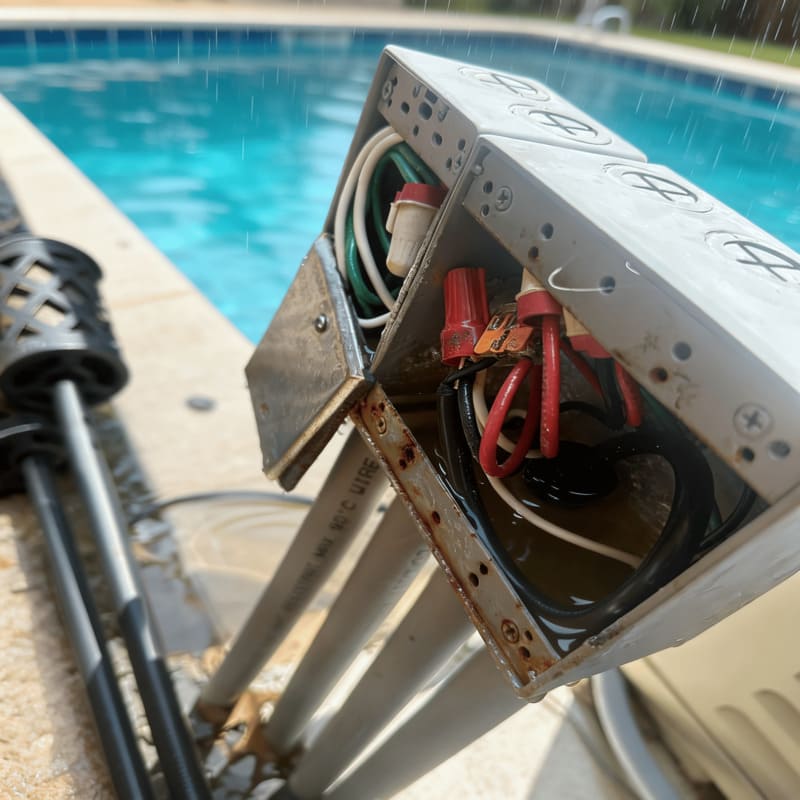
In fact, I often find moisture problems inside the junction box before I find problems inside the light fixture itself.
A pool light junction box is designed to keep water away from electrical connections. However, age, improper installation, and weather exposure can compromise that protection.
Common issues include:
- Cracked junction box covers
- Missing or deteriorated cover gaskets
- Improperly sealed conduit hubs
- Corroded wire splices
- Groundwater entering underground conduit
- Standing water inside the box
I have opened junction boxes after heavy storms and found several inches of water sitting inside. Most homeowners never suspect the junction box because everything appears normal from the outside.
| Inspection Point | What to Check |
|---|---|
| Cover gasket | Cracks, flattening, brittleness |
| Wire splices | Corrosion or discoloration |
| Ground connection | Loose or corroded terminal |
| Conduit hubs | Missing sealant or loose fittings |
| Conduit interior | Water, mud, debris |
| Cord insulation | Cracks, swelling, abrasion |
Water inside a junction box slowly attacks wire connections and insulation. Eventually the leakage current becomes high enough to trip the GFCI whenever moisture levels increase after rain.
How Can You Tell Whether the Breaker, GFCI, or Light Is Faulty?
The goal is to isolate the source of the ground fault rather than replacing parts blindly.
Step 1: Observe the Pattern
Does the breaker trip only after rain?
If so, moisture intrusion becomes the primary suspect.
A failing breaker usually does not care whether it is raining outside.
Step 2: Disconnect the Light
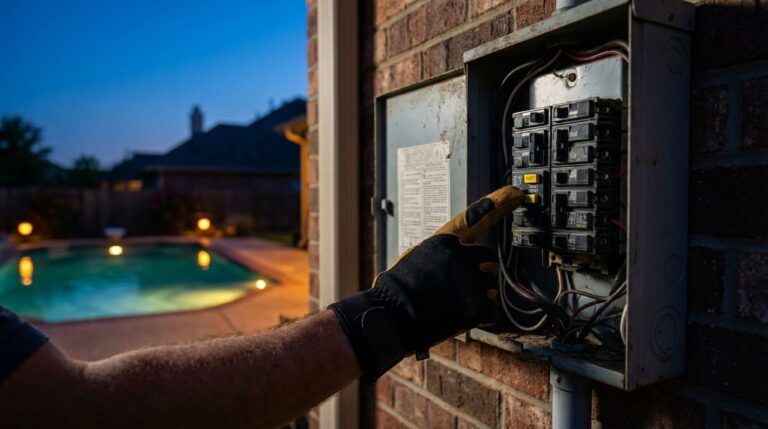
Disconnect the fixture at the junction box and reset the breaker.
- If the breaker now holds, the fault is likely inside the light or cord.
- If it still trips, investigate the wiring, conduit, junction box, or breaker itself.
This single test often eliminates half of the possible causes.
Step 3: Inspect the Junction Box
Look for:
- Standing water
- Condensation
- Corrosion
- Wet wire connectors
- Damaged gaskets
Many moisture faults become obvious once the box is opened.
Step 4: Perform an Insulation Resistance Test
A megohmmeter can quickly identify leakage paths inside the fixture or cable.
Healthy pool light circuits should show very high insulation resistance to ground.
Low readings often indicate moisture contamination or insulation breakdown.
Step 5: Inspect the Niche and Cord
Check for:
- Pinched cords
- Damaged insulation
- Corrosion near the niche
- Physical damage from previous service work
Older installations sometimes develop insulation failures that only become noticeable after prolonged wet weather.
Step 6: Evaluate the GFCI
A defective GFCI is possible, but in weather-related trip scenarios it is far less common than moisture intrusion.
Always investigate the light, conduit, and junction box before replacing the breaker.
Should You Repair the Light or Replace It?
The answer depends entirely on where the fault is located.
If the Problem Is in the Junction Box
Repair is usually straightforward.
Typical repairs include:
- Replacing the gasket
- Installing waterproof wire connectors
- Sealing conduit hubs
- Cleaning corrosion
- Improving drainage
If the moisture source is found early, the fixture itself may still be usable.
If the Problem Is Inside the Fixture
Replacement is usually the better option.
Most modern LED pool lights are sealed assemblies and are not designed for field repair. Once moisture reaches the internal electronics, corrosion often continues even if the light temporarily starts working again.
Considering Replacement Options
When moisture intrusion has already damaged the electronics, replacement is usually more cost-effective than continued troubleshooting.
Many contractors still choose OEM replacements, but aftermarket options have become increasingly common due to rising replacement costs.
One example is the Laze Pool CP-FC-PC55 GloBrite replacement light. Unlike traditional hollow-cavity pool lights, it uses a fully resin-filled construction with thermally conductive potting material surrounding the internal electronics.
From an engineering standpoint, a resin-filled design eliminates the internal air space where condensation can form and improves heat transfer away from the LED driver. These are two of the most common long-term failure points I see in compact LED pool lights.
For pools that experience frequent thermal cycling—such as spas and shallow sun-exposed installations—a fully resin-filled light can provide a more robust alternative while remaining compatible with existing low-voltage lighting systems.
In many retrofit projects, replacement costs are also significantly lower than OEM fixtures, sometimes as little as one-third of the OEM replacement cost.
Practical Recommendations
A few recommendations I give customers during service calls:
- Do not repeatedly reset a tripping GFCI
- Verify the source of the fault before replacing components
- Replace moisture-damaged fixtures rather than attempting temporary repairs
- Upgrade aging junction box seals during replacement
- Test the entire circuit after repairs are completed
A breaker that trips after rain is a safety warning, not merely an inconvenience. The objective is to identify the leakage path and eliminate it permanently.
FAQ
Why does my pool light only trip the breaker when it rains?
Rain increases moisture around the fixture, conduit, and junction box. If an electrical leakage path already exists, the added moisture can push the fault current high enough to trip the GFCI.
Can I keep resetting the breaker until it dries out?
No. A tripping GFCI indicates current leaking to ground. Repeated resets do not solve the underlying problem and may delay identifying a potentially hazardous fault.
Is the breaker itself bad?
It is possible, but weather-related trips are more commonly caused by moisture intrusion somewhere in the lighting system.
Can water inside a pool light be repaired?
In most cases, replacement is the more reliable solution. Once moisture reaches the electronics, corrosion typically continues even if the fixture appears to recover temporarily.
Can rainwater inside the conduit cause a pool light to trip?
Yes. Older conduit systems can accumulate groundwater or rainwater. If the cord insulation has deteriorated, moisture inside the conduit can create a leakage path that trips the GFCI.
Will replacing the light solve the problem?
Only if the light is the source of the fault. Junction box leaks, damaged wiring, and water-filled conduit should also be inspected before replacing any fixture.
Is a tripping pool light dangerous?
The tripping itself is actually the safety system doing its job. The concern is the underlying ground fault. Any pool light circuit that repeatedly trips should be inspected and repaired promptly.
About the Author: Howard Wang is a Senior Product Engineer with over 10 years of experience in the swimming pool equipment industry, specializing in underwater LED lighting systems, waterproofing structures, thermal management, and contractor-focused troubleshooting solutions.