The pool light replacement market has changed significantly over the past few years.
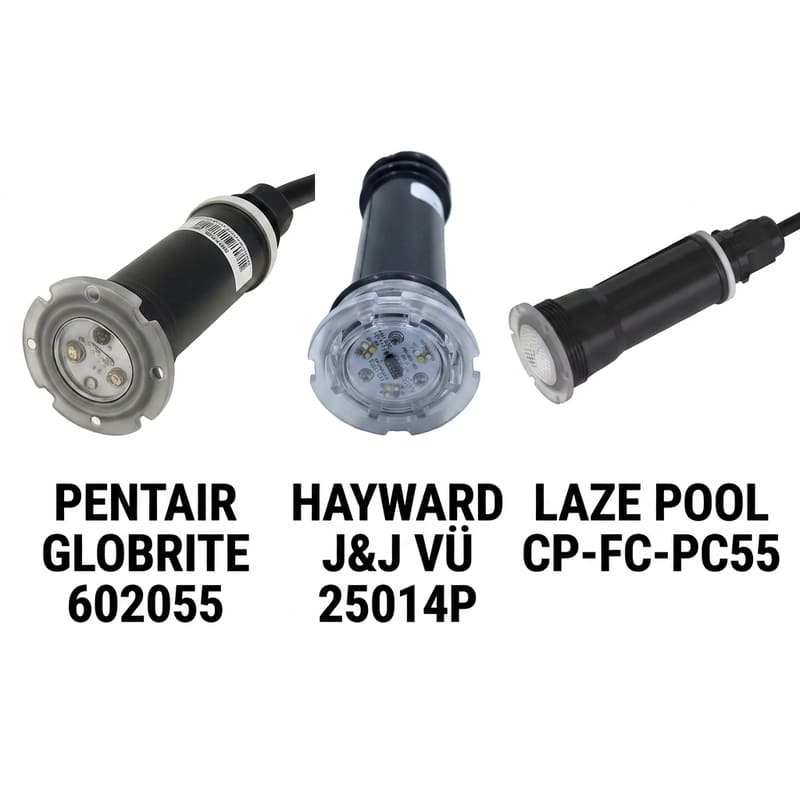
For more than a decade, Pentair GloBrite has been one of the most widely installed nicheless pool lights in the United States. Because so many pools were built around the GloBrite ecosystem, replacing a failed light often meant buying another GloBrite.
Today, that is no longer the only option.
As more pools age, contractors and homeowners are increasingly comparing OEM replacements with other alternatives. J&J Electronics offers the VÜ Retro as a premium brand option, while newer resin-filled aftermarket products have entered the market with different engineering approaches aimed at improving waterproofing and thermal management.
This article compares all three options from the perspective of an engineer who has spent more than ten years working with underwater LED lighting systems and failed-unit analysis.
Quick Answer
For most pool owners replacing a failed nicheless light, the decision usually falls into three categories:
- Pentair GloBrite (~USD 500) — OEM product with an established ecosystem
- J&J VÜ Retro (~USD 450–600) — Premium brand alternative
- Resin-filled aftermarket (~USD 100–300) — Newer designs that eliminate the internal air cavity
All three are intended for standard 1.5-inch nicheless installations and can work with Pentair automation systems when designed for compatibility.
The biggest differences are not installation difficulty, but:
- Construction approach
- Long-term maintenance considerations
- Purchase price
- Overall replacement strategy
If the original GloBrite is still under warranty, staying with OEM often makes sense.
If a homeowner prefers an established alternative brand, J&J is a reasonable option.
If durability improvements and lower replacement cost are priorities, quality resin-filled aftermarket lights deserve serious consideration.
Why Are So Many Pool Owners Replacing GloBrite Lights?
GloBrite became successful because it solved a real installation problem. The compact nicheless design made pool construction easier, and millions of pools were built around this platform.
As that installed base has grown older, discussions about replacement have become much more common across contractor communities, Reddit, and Trouble Free Pool forums.
The issues most frequently reported include:
- Water intrusion and fogged lenses
- LED burnout
- Color synchronization problems
- Cracked housings near the cable entry
- GFCI trips after moisture exposure
In my own field experience, many homeowners begin looking for alternatives much earlier than they originally expected, especially in demanding environments such as spas and heavily heated pools.
Whether these failures are related to design limitations, operating conditions, thermal cycling, or other factors, the practical result is the same:
People are no longer asking only how to replace a GloBrite. They are asking what they should replace it with.
That is where this comparison begins.
Pentair GloBrite vs J&J VÜ Retro: What's the Difference?
J&J Electronics is one of the better-known names in the pool lighting industry. The VÜ Retro is often selected by contractors and builders who want a premium alternative without moving too far away from the traditional nicheless replacement approach.
| Specification | Pentair GloBrite | J&J VÜ Retro |
|---|---|---|
| Manufacturer | Pentair | J&J Electronics |
| Standard 1.5" fitting | Yes | Yes |
| Pentair automation compatible | Yes | Yes |
| LED color-changing | Yes | Yes |
| Typical retail price | ~USD 500 | USD 450–600 |
| Warranty | Manufacturer-backed | Manufacturer-backed |
From a replacement strategy perspective, both products belong to the traditional sealed-cavity style of nicheless pool lighting.
For homeowners who value established brands and dealer support, J&J can be an attractive option.
It is important to understand, however, that changing brands does not necessarily mean changing the underlying engineering approach.
For many customers, J&J makes sense when:
- They prefer a recognized manufacturer
- Their contractor regularly installs J&J products
- Brand support and distribution are important considerations
Do Aftermarket Alternatives Really Last Longer?
This is where the conversation becomes more interesting.
The real question is not simply OEM versus aftermarket.
It is whether a different construction method can reduce some of the problems contractors repeatedly encounter during repairs.
Hollow-Body vs Resin-Filled Construction
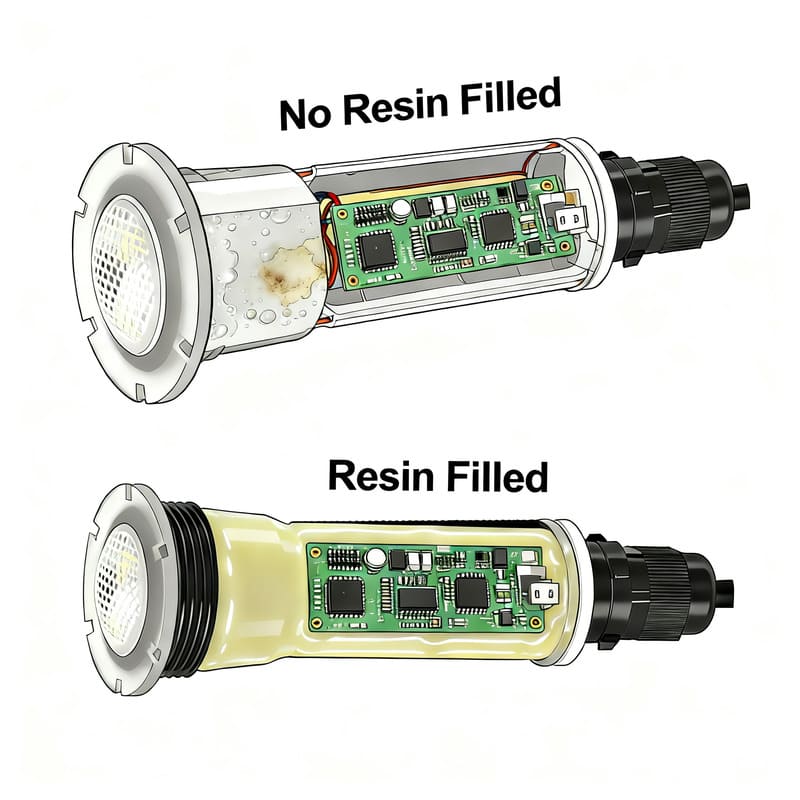
Traditional nicheless pool lights generally rely on a sealed internal cavity that houses the electronic components.
Based on failed units I have inspected over the years, moisture reaching internal electronics is one of the most common issues associated with underwater LED lights.
Typical failure progression often looks like this:
- Repeated thermal cycling
- Long-term seal stress
- Moisture entering the housing
- Condensation around electronic components
- Driver board damage
A newer category of aftermarket products uses fully potted, resin-filled construction.
Instead of leaving an internal air cavity, the electronics are encapsulated inside thermally conductive resin.
| Construction Detail | Traditional Design | Resin-Filled Design |
|---|---|---|
| Internal air cavity | Yes | No |
| Driver board exposure | Internal cavity | Fully encapsulated |
| Thermal management | Air-based | Conductive resin |
| Condensation around electronics | Possible | Reduced |
| Field repair | Not practical | Not practical |
The resin-filled approach addresses one of the failure pathways that contractors frequently discuss during service work.
With no internal air space surrounding the electronics, there is less opportunity for condensation to accumulate directly around the driver board.
One example is Laze Pool's CP-FC-PC55, which uses thermally conductive resin to encapsulate the internal electronics. The resin also functions as a heat transfer path, helping move heat away from the LED assembly.
What This Means in Practice
Resin-filled construction is not simply a marketing term. It is a different engineering approach.
However, actual service life depends on many variables, including:
- Operating temperature
- Water chemistry
- Climate
- Installation quality
- Component selection
- Manufacturing consistency
A poorly built resin-filled light is not automatically better than a well-built traditional design.
But quality resin-filled products do remove one of the failure mechanisms commonly encountered during pool light repairs.
Installation and Pentair Automation Compatibility
For most contractors, the practical question is straightforward:
Will it work with the existing system?
For GloBrite, J&J VÜ Retro, and quality aftermarket replacements designed for Pentair systems, the answer is generally yes.
| Compatibility Requirement | GloBrite | J&J VÜ Retro | Quality Aftermarket |
|---|---|---|---|
| Standard 1.5" fitting | Yes | Yes | Yes |
| IntelliTouch compatible | Yes | Yes | Verify |
| EasyTouch compatible | Yes | Yes | Verify |
| IntelliCenter compatible | Yes | Yes | Verify |
| Standard color-change logic | Yes | Yes | Verify |
| Controller replacement required | No | No | No |
When evaluating an aftermarket replacement, always verify that Pentair automation compatibility is specifically listed by the manufacturer.
From an installation standpoint, these products follow the same general replacement process, and selecting one over another does not usually increase installation complexity.
Cost Comparison: Is Paying USD 500 Still Worth It?
Eventually, every replacement decision becomes a value decision.
| Product Category | Typical Retail Price |
|---|---|
| Pentair GloBrite | ~USD 500 |
| J&J VÜ Retro | USD 450–600 |
| Aftermarket on Amazon / eBay | USD 250–350 |
| Direct resin-filled aftermarket | USD 100–200 |
For a homeowner replacing multiple failed lights, the cost difference can become significant.
Looking Beyond the Purchase Price
The fixture itself is only part of the total repair cost.
Labor, service visits, cable pulling, troubleshooting, and future replacements all contribute to long-term ownership cost.
If a replacement design can reduce future service work, the overall ownership experience may improve even when initial purchase prices are similar.
Actual lifespan varies widely depending on usage patterns and environmental conditions, so assigning a universal service life to any pool light design is difficult.
When OEM Pricing Still Makes Sense
There are still situations where I recommend OEM products:
- Existing Pentair warranty coverage
- Commercial projects with strict specifications
- Property management requirements
- Homeowners who strongly prefer OEM equipment
For many out-of-warranty residential repairs, however, homeowners are now considering alternatives that offer a different balance between price and engineering approach.
Which Replacement Is the Best Choice for Your Pool?
There is no universal answer.
Different situations call for different solutions.
Choose Pentair GloBrite if:
- The system is still under warranty
- OEM parts are required
- Dealer support is a priority
- Brand consistency matters
Choose J&J VÜ Retro if:
- You prefer an established alternative brand
- Your contractor regularly installs J&J products
- Manufacturer backing is an important factor
Choose a Quality Resin-Filled Aftermarket Light if:
- The original GloBrite has already failed out of warranty
- The pool or spa experiences aggressive thermal cycling
- Lower replacement cost is important
- You want a different engineering approach to waterproofing
- Multiple fixture replacements make budget a significant consideration
The pool light market offers more choices today than ever before.
Some homeowners prioritize familiar brands.
Others focus on engineering changes and long-term maintenance considerations.
Understanding those trade-offs is far more valuable than simply choosing the most recognizable logo.
FAQ
Is the J&J VÜ Retro better than the GloBrite?
J&J VÜ Retro is a premium alternative from an established manufacturer. For many homeowners, it provides a strong brand-backed replacement option.
Will an aftermarket light work with my IntelliCenter?
Many aftermarket lights are designed for Pentair automation compatibility. Always verify that IntelliCenter, IntelliTouch, and EasyTouch support are listed in the product specifications.
Why are resin-filled lights considered more durable?
By eliminating the internal air cavity, resin-filled designs reduce the opportunity for moisture to accumulate directly around electronic components.
Can I mix brands on the same automation system?
In many cases, yes. As long as the fixtures support compatible color-change logic, different brands can often operate on the same Pentair automation platform.
What is the warranty difference between OEM and aftermarket?
Warranty terms vary by manufacturer. Before purchasing, review warranty coverage, product support, and replacement availability.
Which option is best for a spa or heated pool?
Spas and heated pools often experience more aggressive temperature changes. Many contractors therefore pay close attention to waterproofing structure and thermal management when selecting replacement lights.
About the Author
Howard Wang is a senior product engineer with over 10 years of experience in pool lighting systems, waterproof structures, LED thermal management, and long-term product reliability.