You get a quote to replace a dead pool light. The number stops you cold. $1,100? For a light bulb?
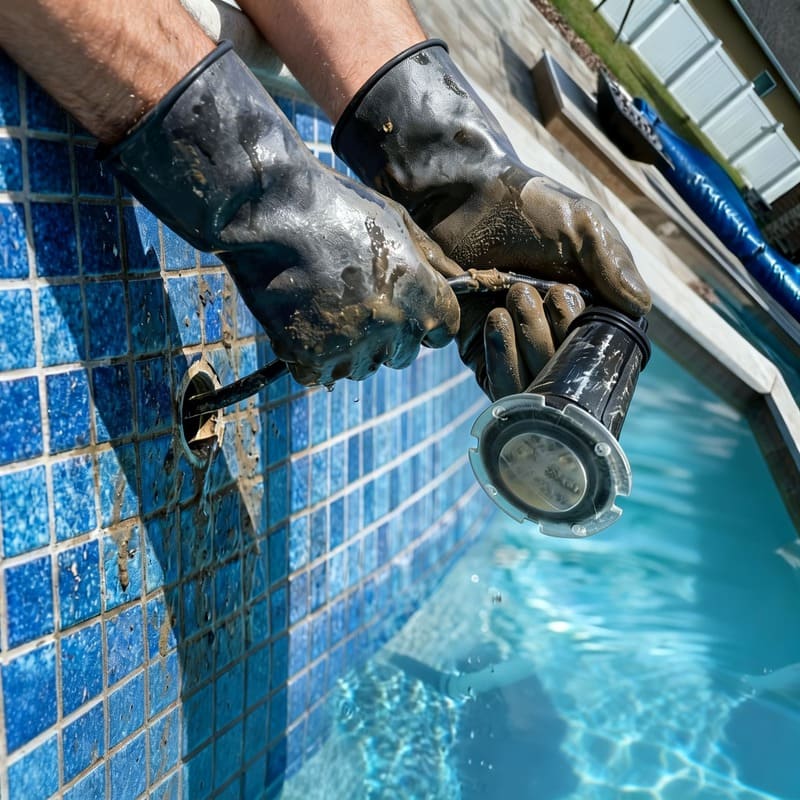
Most homeowners assume replacing a pool light is like changing a bulb in their kitchen. It is not. I have been a pool technician and engineer for over a decade, pulling swollen, muddy light cords through 100 feet of underground PVC conduit. I can tell you exactly why that bill is so high.
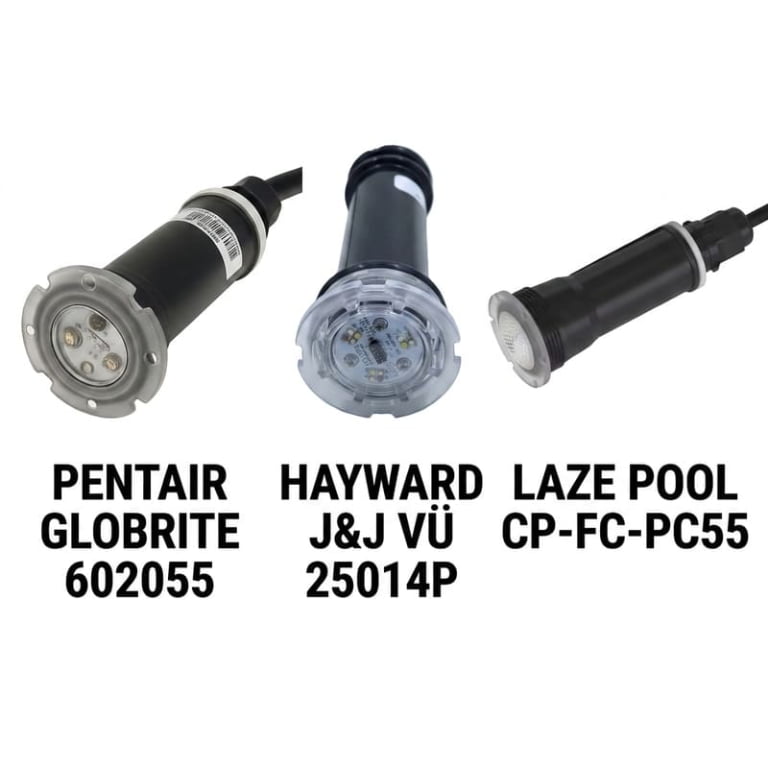
Replacing a pool light in 2026 typically costs between $600 and $1,500 for a single fixture. If you have a nicheless 12V LED system—like the infamous Pentair GloBrite—you aren't just replacing a bulb; you are pulling out the entire sealed unit and wiring it all the way back to the junction box.
There is a lot going on inside that $1,000+ quote. The type of light you have, the nightmare of underground conduit, and the massive "middleman markups" in the pool industry all inflate the final price. I want to walk you through exactly where your money is going—because once you know the industry secrets, you can easily cut this bill in half.
What Are You Actually Paying For When You Replace a Pool Light?
When you look at a $1,100 quote, your first reaction is that the pool guy is ripping you off. The truth? The pool guy is probably charging fair labor, but the parts are where the robbery happens.
A licensed pool electrician in the US typically charges between $150 and $250 per hour. A standard light pull should take 60 to 90 minutes. But if that 75-foot conduit has shifted underground, is filled with hardened mud, or the old cord has swelled up, a 1-hour job turns into a 3-hour wrestling match. Pool companies quote high labor rates upfront to cover their risk. On the Trouble Free Pool (TFP) forums recently, one homeowner shared a quote where a pool company charged $620 strictly for labor to pull one GloBrite cord.
Here is what a realistic 2026 quote actually contains:
| Cost Component | Typical Range | The Engineer's Reality Check |
|---|---|---|
| Service Call / Diagnostic Fee | $75 – $150 | They charge this just to drive to your house and look at the water. |
| Labor (1–3 hours) | $200 – $650 | Usually takes 2 guys. One to push the fish tape, one to pull the cord. |
| OEM Light Fixture (e.g., GloBrite) | $450 – $550 | This is the cost of the raw part on Amazon or at Leslie's. |
| Conduit or Wiring Work (if snagged) | $100 – $400 | If the old cord breaks inside the pipe, the nightmare begins. |
| Total Professional Quote | $825 – $1,750+ | Per light. Yes, if you have 3 dead lights, expect a $3,000+ bill. |
The fixture itself is the biggest scam. A 100-ft OEM Pentair GloBrite retails for around $500. That is before anyone even touches your pool equipment.
But here is the secret: The only variable you have real control over is the fixture itself. Labor rates in your ZIP code are fixed. But the light you buy? That is a choice.
Does the Type of Pool Light Change the Cost?
Not every pool light replacement is the same job. As a pool engineer, I price jobs entirely based on what fixture is sitting in that wall.
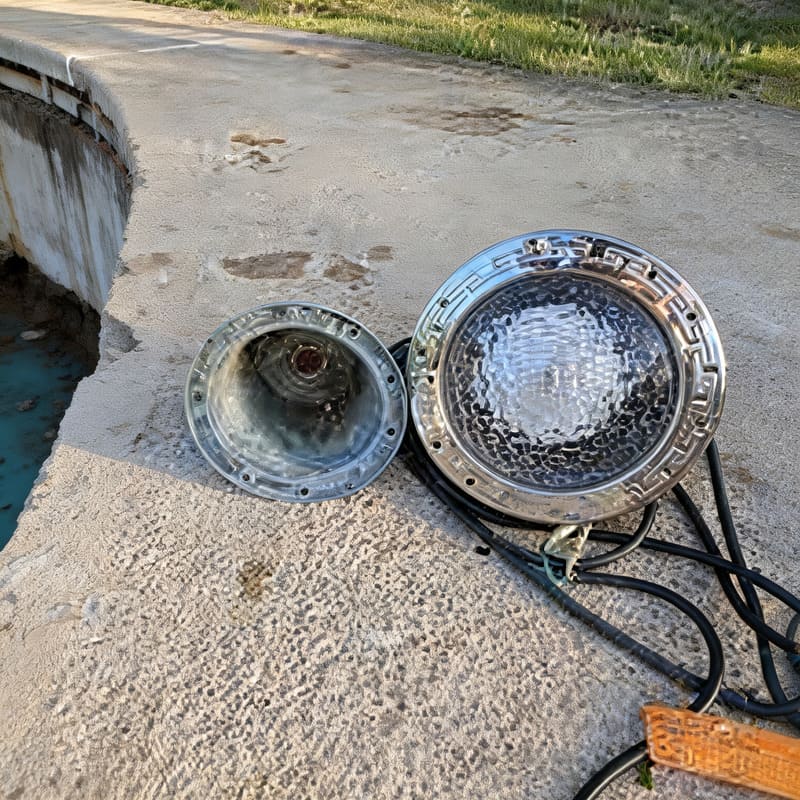
A 12V nicheless light (like the GloBrite or MicroBrite) sits inside a tight 1.5-inch pipe built into your pool wall. Older pools use massive 120V incandescent fixtures (like the Amerlite) inside a 10-inch stainless steel niche. The size of the niche and the length of the cord dictate the misery of the job.
Here is how cost typically breaks down by light type:
| Light Type | Parts Cost | Labor Cost | Total Estimate |
|---|---|---|---|
| 12V Nicheless (e.g., GloBrite) | $400 – $550 | $300 – $650 | $700 – $1,200+ |
| 120V Full-Size Niche Light | $250 – $450 | $200 – $500 | $450 – $950 |
| Standard LED Bulb Retrofit | $50 – $150 | $150 – $300 | $200 – $450 |
| Spa Light (small 12V niche) | $200 – $400 | $200 – $500 | $400 – $900 |
The 12V nicheless lights are consistently the most expensive to maintain. Why? Because you cannot just "change the bulb." The entire unit is sealed. When a GloBrite dies, you are throwing away a $500 piece of plastic and paying a guy $400 to pull 100 feet of wire out of the ground.
Engineer’s Tip: Make sure the quote specifies if the pool needs to be drained. Most 12V and 120V lights have enough cord coiled inside the niche to be pulled up to the deck and swapped underwater. If a pool tech tries to charge you $300 to drain your pool for a standard light swap, find a new tech.
Are You Overpaying for the Light Itself? (The Middleman Markup)
This is the part of the conversation that pool service companies and major US brands absolutely do not want you to hear.
If you go to Reddit, you'll see people furious that their $500 Pentair GloBrites are burning out or flashing red after just 2 or 3 years. You might think: "I'll just buy a premium American aftermarket brand like Pool Tone or Moov or No More Gree, etc."
Welcome to the Middleman Markup.
Many "premium" US-based lighting companies are simply importing LED fixtures from overseas factories for $50 to $90 a piece. They put the light in a nice box, slap their logo on it, and sell it to you for $350 to $450. You aren't paying for superior engineering; you are paying for their warehouse rent and Google Ads budget.
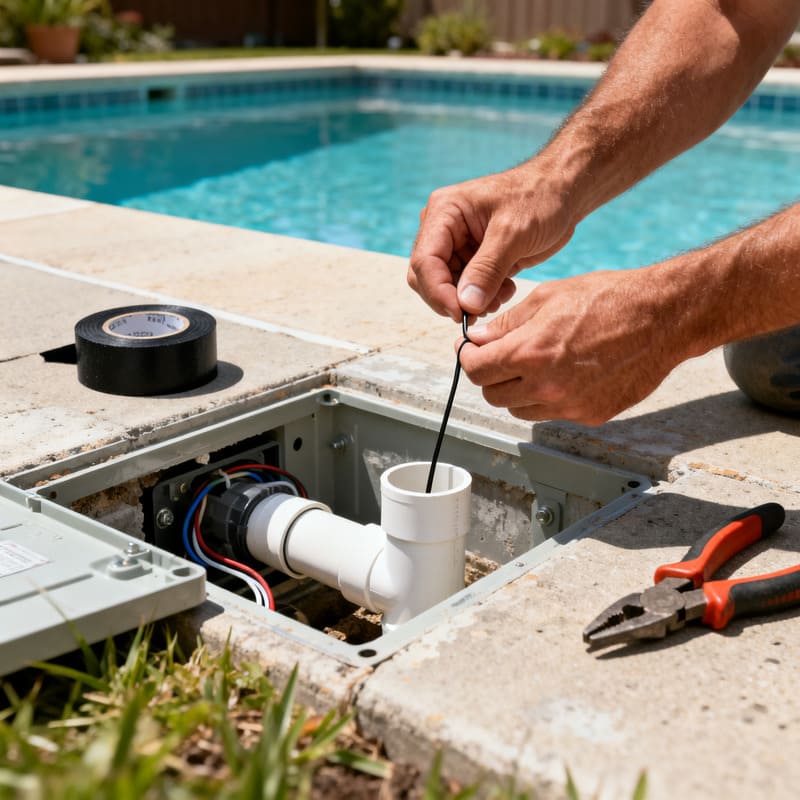
Here is what the industry supply chain actually looks like:
| Stage | Who Is Involved | What Happens to the Price |
|---|---|---|
| Manufacturing | Overseas Factory | Base production cost ($50 - $90) |
| The "Middleman" | US Importer / Brand | Adds a 300% to 400% markup just for branding ($350+) |
| Pool Service Company | Your contractor | Adds a 20% margin on top of the distributor price |
| End Customer | You | You pay $450 - $600 for a $90 light. |
As an engineer, I tell my clients to stop falling for the "OEM Trap." The original Pentair GloBrite has a famously documented design flaw: the thermal cycling causes the plastic lens to micro-crack. Pool water seeps in, the circuit board corrodes, and the light dies. Why would you pay a 400% markup for an OEM light that is mathematically guaranteed to fail again in 3 years?
There is a better way. We source direct replacement lights that skip the middlemen entirely. Our replacement lights use upgraded, market-tested sealing technology to prevent the exact cracks that kill OEM lights. Because we cut out the importers, our lights are priced at 1/3 to 1/4 of the OEM price. Same 1.5-inch niche, same 12V system, seamless sync with Pentair automation—just without the ridiculous price tag.
Can You Replace a Pool Light Yourself — And How Much Would You Save?
This is the golden question. When I tell a homeowner the labor will be $600, their next question is always: "Can I just do it myself?"
If you have a 12V low-voltage system (like a GloBrite or MicroBrite), the answer is usually Yes. You are not dealing with lethal 120V mains power; you are dealing with harmless 12V landscape-level power coming from a transformer.
By pulling the cord yourself, you immediately wipe $300 to $600 off your bill.
Here is a clear, brutally honest guide on when to DIY:
| Situation | DIY Realistic? | The Engineer's Verdict |
|---|---|---|
| 12V Nicheless swap (Globrite to Aftermarket) | Yes, for most | It's just taping the new cord to the old cord and pulling. Use plenty of Dawn dish soap as lube. |
| 120V Full-size light replacement | No | Mixing 120V AC power with pool water is how people die. Call a pro. |
| GFCI keeps tripping instantly | No | You have a hard electrical short, or water in the junction box. |
| Old cord is completely stuck in the pipe | No | If pulling breaks the cord mid-pipe, you need professional vacuum lines and snakes to clear the conduit. |
| Water inside the lens, flashing random colors | Yes | The light seal failed. Swap the fixture yourself. |
If you tape the new cord to the old one, lube it up, and pull it smoothly through the conduit to the junction box, your total cost is literally just the cost of the replacement light. Compare a $150 aftermarket light to a $1,100 pool guy quote, and the DIY route becomes very attractive.
What Hidden Fees Do Pool Companies Not Mention Upfront?
If you decide to hire a pro, be prepared for the final invoice to look different from the verbal quote.
In the pool service industry, "unforeseen complications" are our bread and butter. Many of these fees are legitimate (underground pipes are unpredictable), but they are rarely explained to the homeowner before the trench gets dug.
Watch out for these common hidden hits:
| Hidden Fee | What It Is | Typical Cost |
|---|---|---|
| Trip Charge / Diagnostic | Charged just to park the truck in your driveway | $75 – $150 |
| The "OEM-Only" Policy | Many companies refuse to install cheaper aftermarket lights | You pay $500 retail instead of $150 |
| Conduit Clearing / Snaking | If the pipe is full of mud, it takes 2 hours to clear | $150 – $300 |
| Pool Drain & Refill | Lazy techs who don't want to get wet | $200 – $500 |
| Warranty Labor Fee | Yes, even if Pentair gives you a free warranty light, the pool guy still charges labor to install it | $200 – $400 |
The one that angers homeowners the most is the OEM Parts Policy. Many large pool companies will only install genuine Pentair or Hayward fixtures. They claim it is for "warranty reasons," but the reality is they make a massive margin on selling you a $500 light. Demand an itemized quote, and ask explicitly: "Will you install a compatible aftermarket light if I provide the part?"
When Is It Worth Paying a Professional — And When Is It Not?
Knowing when to write the check and when to grab your toolbelt is the most important decision you'll make.
Paying a professional $500 to pull a 30-foot cord through a clean, straight PVC pipe is a waste of money. But trying to play electrician when your junction box is corroded is incredibly dangerous.
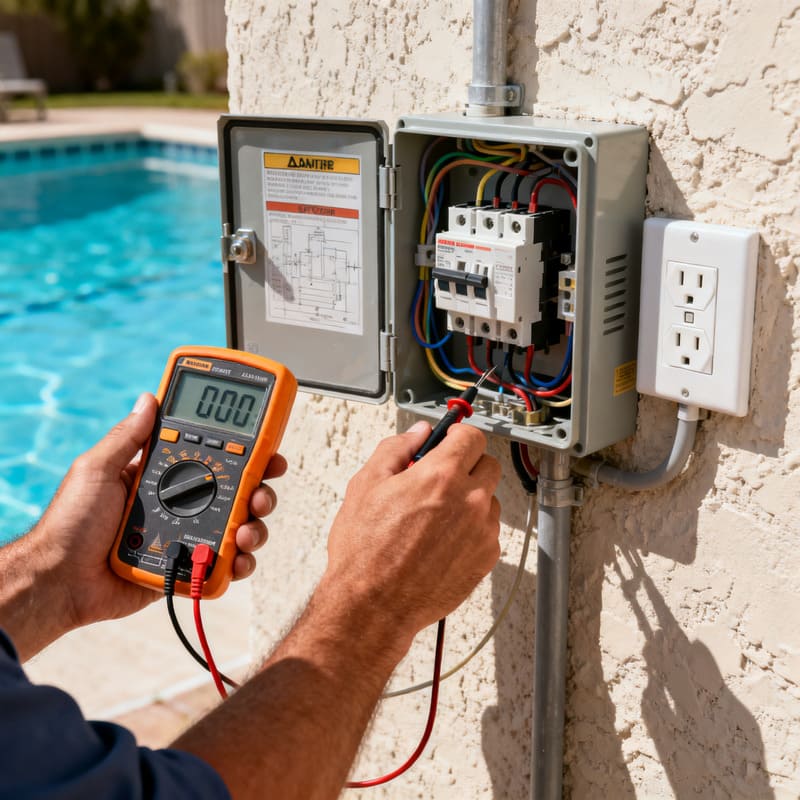
Here is my direct, 10-year field guide:
| Situation | Hire a Pro? | Reason |
|---|---|---|
| 12V Nicheless Swap (Straight conduit run) | No | It's purely mechanical. Tape, lube, and pull. |
| GFCI trips immediately upon flipping breaker | Yes | Electrical fault. Could be a fried transformer or exposed wire. |
| Conduit is cracked, roots growing inside | Yes | Requires digging up the deck and laying new PVC code-compliant conduit. |
| Replacing a 120V Amerlite | Yes | High voltage near water. Do not risk your family's life to save $200. |
| Light flickers or cycles colors randomly | No | Usually a burned-out LED driver inside the unit. Just replace the fixture. |
My golden rule: If the issue is contained within the sealed light fixture itself (water in the lens, dead LEDs, cracked plastic), you can do it yourself. If the issue is in the breaker panel, the junction box, or the underground pipe, call someone who carries commercial liability insurance.
How Do You Cut the Cost Without Cutting Corners?
Replacing a pool light in 2026 is expensive, but a massive chunk of that cost is entirely avoidable if you stop playing by the pool industry's rules.
Here is the exact blueprint I give to my friends and family to bypass the bloated costs:
Step 1: Confirm the light is actually dead.
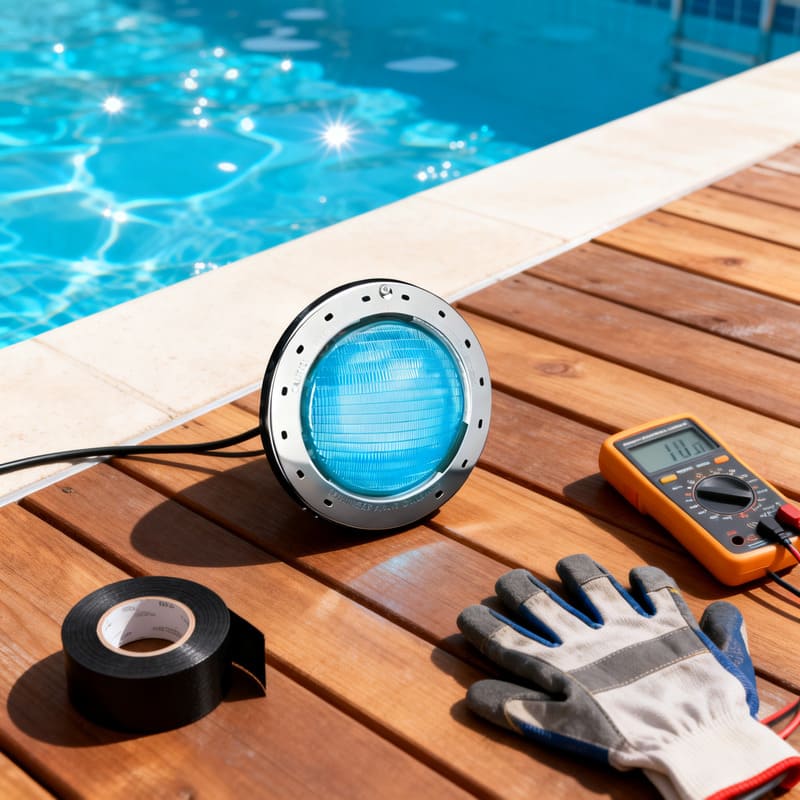
Don't buy a $400 light because your current one won't turn on. Check the GFCI outlet. Check the 12V transformer output with a multimeter. A $50 blown landscaping transformer acts exactly like a dead pool light. Diagnose before you buy.
Step 2: Know your exact fixture model.
A direct replacement is easy. A mismatched light means chipping concrete or buying expensive adapter rings. If your wall has a 1.5-inch pipe, you need a standard nicheless light like a Globrite replacement.
Step 3: Skip the "Middleman" and the OEM Trap.
Do not buy a $500 OEM light with known cracking issues. And do not pay $400 to a middleman brand that just imported a light and slapped a sticker on it. Our aftermarket lights are built with superior resins to stop the cracking, sync perfectly with your automation, and cost 1/3 to 1/4 the price of the original manufacturer's light.
Step 4: Ask your pool tech for a "Labor-Only" install.
If you don't want to pull the cord yourself, buy the high-quality aftermarket light yourself, set it on the pool deck, and hire an independent pool tech just for the labor. You instantly save the 200% parts markup.
Step 5: Buy a spare while you are at it.
If you have two GloBrites and one dies, I promise you, the second one will die within 6 months. Buy two replacements at the lower aftermarket price. Keep one in the garage. When the second one flashes red and dies, you aren't held hostage by supply chain delays.
The Bottom Line: Labor is fixed, but the fixture is your choice.
US labor rates are not going down. The pool guy quoting you $400 to pull a cord is just trying to run a business in 2026.
But the $500 light fixture? The middleman markups? The OEM design flaws? That is entirely in your hands. Stop paying premium retail prices for plastic lights that are designed to fail. Buy a smarter, direct-to-consumer aftermarket alternative, grab some dish soap and fish tape, and take control of your own pool maintenance.
✍️ About the Author
Howard Wang – Senior Product Engineer at Laze Pool
With over 10 years of experience in the swimming pool equipment industry, Howard specializes in LED thermal management and waterproofing solutions. He works directly with US distributors and contractors to develop resin-filled alternatives that solve common OEM failure points.